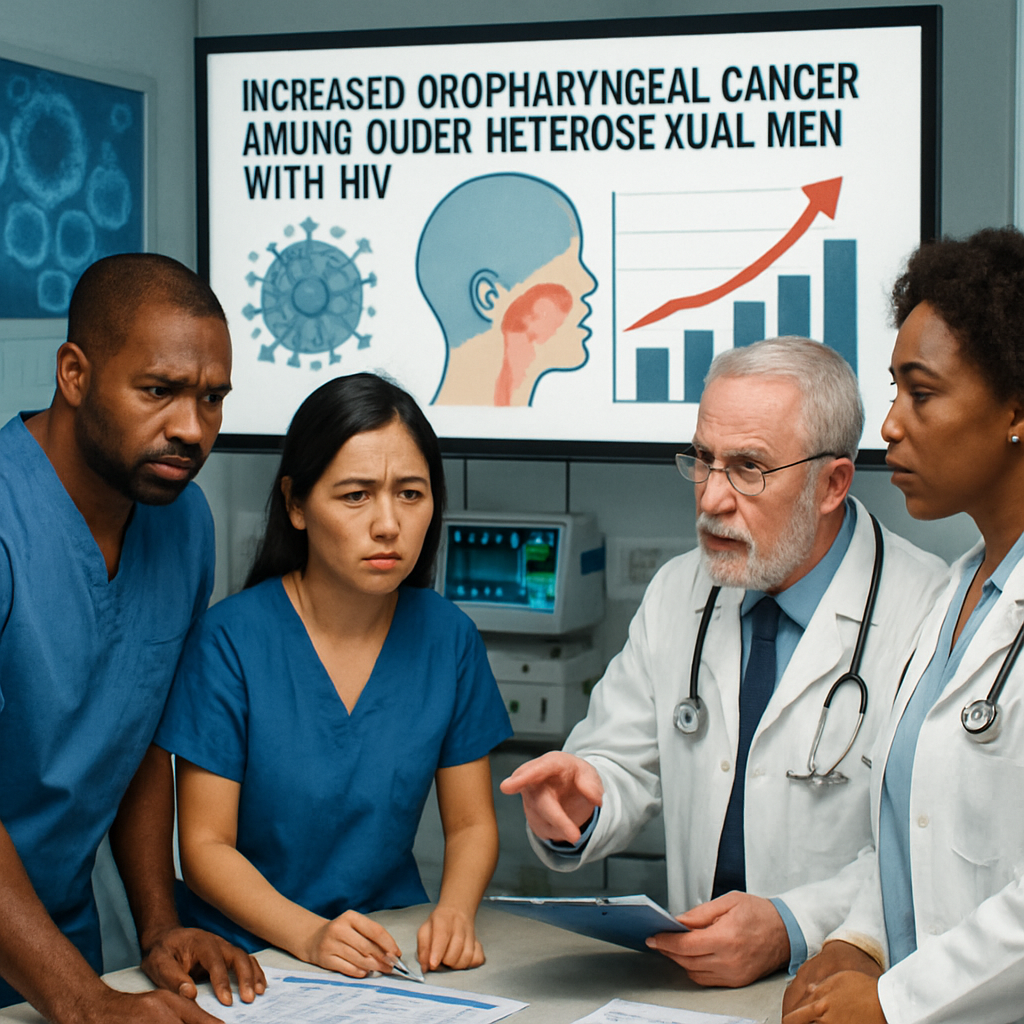
Rates of oropharyngeal cancer among people with HIV have jumped since 2000, particularly heterosexual men ages 50 and older, according to an observational study.
In a large North American HIV cohort, there were 55 new cases of oropharyngeal cancer in 2015-2017 and 49 new cases in 2018-2020 compared with 14 new cases in 2000-2002 and 23 new cases in 2003-2005, reported Antonio Bandala-Jacques, MD, ScM, of the Johns Hopkins Bloomberg School of Public Health in Baltimore and a research analyst at AbbVie, at the Conference on Retroviruses and Opportunistic Infectionsopens in a new tab or window.
The incidence rate increased across all age groups — those under 45 at study entry, those ages 45-59, and those 60 and older — but the increases were sharpest among the two younger cohorts since 2007-2013.
The overall incidence rate of oropharyngeal cancer over this time period was 29 cases per 100,000 people, with an adjusted incidence rate ratio (aIRR) of 1.5 for heterosexual men compared with men who have sex with men and an aIRR of 2.3 for those ages 50-59 versus those 40-49.
“The rates of oropharyngeal cancer in people living with HIV have nearly tripled since the year 2000,” Bandala-Jacques said. “Age over 50, low CD4 nadirs, smoking, alcohol consumption, and heterosexual contact are associated with increased oropharyngeal cancer rates.”
“Oropharyngeal cancer is no longer a rare cancer in certain people living with HIV,” he added.
Flavia Kiweewa Matovu, MBChB, MSc, PhD, a senior research scientist at Makerere University in Kampala, Uganda, told MedPage Today that the increase in oropharyngeal cancer over time is “alarming,” and the reasons for this increase are unclear.
Clinicians need to look out for these cancers and be able to diagnose them and intervene early, “because the earlier you intervene, the better the prognosis,” she said.
Because the majority of people in the cohort were not vaccinated against human papillomavirus (HPV), Kiweewa Matovu noted that those eligible for HPV vaccination should get the vaccine, but she also stressed that it is necessary to collect more data about younger individuals with HIV and to understand the effectiveness of the vaccine in people with HIV, including the duration of protection. “Importantly, we need to continue screening,” she added.
For this study, the researchers used data from the North American AIDS Cohort Collaboration on Research and Design for all cohorts with validated cancer data from January 2000 to December 2020, which included 135,359 individuals with approximately 850,000 person-years.
The 254 study participants with oropharyngeal cancer had a median age of 58, 95% were men, 52% were white, and 41% were Black. The 134,805 without cancer had a median age of 50, 86% were men, 45% were white, and 40% were Black.
The median CD4 count was significantly lower in those with oropharyngeal cancer (160 cells/mm3) versus those without (253 cells/mm3). More participants with oropharyngeal cancer had ever smoked (82%) and excessively consumed alcohol (41%) compared with those without cancer (73% and 22%, respectively).
The incidence rate of oropharyngeal cancer was higher among males versus females (31.4 vs 10.9 per 100,000 person-years), and was highest in the 50-59 age group (49.2 per 100,000 person-years), though the rate was similarly high for those ages 60-69 and 70 and older (41.2 and 39.7 per 100,000 person-years), and lowest for those under 40 and those ages 40-49 (2.9 and 19.4 per 100,000 person-years, respectively).
Compared with those ages 40-49, the aIRR was 0.2 for those under 40 and 1.9 for those ages 60 and older.
Incidence rates were higher among heterosexual men (47.9 per 100,000 person-years) and people who inject drugs (44.3 per 100,000 person-years) compared with men who have sex with men (26.4 per 100,000 person-years) and females (10.6 per 100,000 person-years).
The aIRR for women was half that of men (0.5). Compared with men who have sex with men, the aIRR was 0.5 for heterosexual females and 1.1 for people who inject drugs.
The incidence rate among those with a CD4 nadir below 200 cells/mm3 was 36.4 per 100,000 person-years, about double that of those with a count of 500 cells/mm3 or higher (14.9 per 100,000 person-years).
For ever-smokers, incidence rates were higher versus never-smokers (35.8 vs 22.1 per 100,000 person-years), and the same was true for those with a history of any excessive alcohol use versus those with no such history (42.1 vs 23.6 per 100,000 person-years).
Fuente: https://www.medpagetoday.com/meetingcoverage/croi/120019
Join the doctors who get the most relevant medical news, curated by specialty, every week — no spam, unsubscribe anytime.