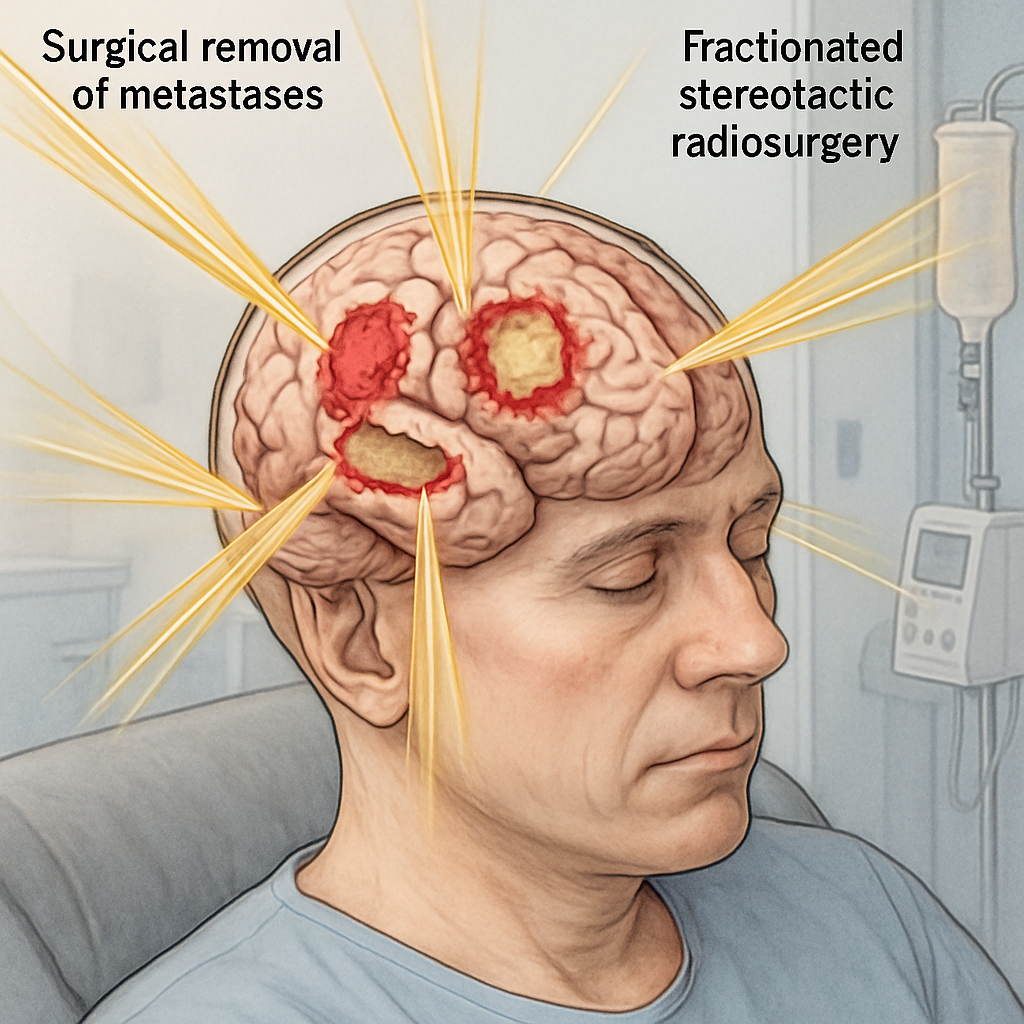
Local control after surgical removal of large brain metastases improved significantly when patients received fractionated stereotactic radiosurgery (SRS) instead of single-fraction SRS, as shown in a randomized trial.
Surgical-bed Control Improvement
Surgical-bed control at one year improved from 81% with single-fraction SRS to 87% with fractionated SRS. Furthermore, fewer patients in the latter group required salvage treatment with whole-brain radiation therapy (WBRT). Overall survival (OS), a secondary endpoint, also showed improvement, increasing from 20.2 months to 28.6 months.
No Increased Toxicity
The benefits of fractionated SRS were achieved without an increase in toxicity, as reported by Dr. Ayal Aizer from Mass General Brigham and Dana-Farber Cancer Institute at the American Society for Radiation Oncology (ASTRO) annual meeting in Boston.
Dr. Aizer stated, “Fractionated stereotactic radiosurgery improves surgical-bed control compared with single-fraction stereotactic radiosurgery after resection of a brain metastasis, and this improvement was achieved without an increase in toxicity.” He emphasized that for patients undergoing resection of a larger brain metastasis, postoperative fractionated stereotactic radiosurgery should now be considered the standard of care.
Study Significance
The study moves fractionated radiosurgery from a reasonable practice supported by retrospective data to one backed by robust randomized phase III trial evidence. Dr. Aizer noted, “We now have the strongest evidence to date that three to five sessions of SRS should be considered a standard postoperative treatment for patients with larger brain metastases.”
Need for More Comparative Trials
All existing radiotherapy approaches have distinct advantages and disadvantages, and clinical trials comparing different modalities are necessary to determine the optimal approach, according to Dr. Rupesh Kotecha from Baptist Health Herbert Wertheim Cancer Institute. Although the results indicated a significant improvement in surgical-cavity local control without increased toxicity, the difference in overall survival warrants further investigation.
Conclusions
Dr. Kotecha summarized, “The bottom line: If postoperative external beam radiotherapy is chosen after upfront resection, then postoperative fractionated radiosurgery is the new standard of care.”
Dr. Aizer also mentioned that prior randomized trials had established single-fraction SRS as the standard of care but noted high recurrence rates in surgical beds. A subset analysis revealed that larger metastases were particularly more prone to poor surgical-bed control.
Trial Details
Multiple retrospective studies have indicated that fractionated SRS achieves good local control, generally with three to five fractions. The multicenter A071801 trial compared single-fraction SRS to fractionated SRS in patients with up to four brain metastases, including one resected metastasis larger than 2 cm.
In the trial, 242 patients were randomized, with 223 evaluable for the primary endpoint. The primary analysis revealed that fractionated SRS reduced the hazard for surgical-bed control by 47%. Patterns and rates of intracranial recurrence were similar between the groups, with new brain metastases being the most common type of recurrence.
Freedom from salvage WBRT at one year also showed a preference for the fractionated arm, with 94% versus 84%. The difference in median OS translated into a hazard ratio in favor of fractionated SRS.
Rates of radiation necrosis and cerebral edema were comparable between single-fraction and fractionated SRS groups.
Disclaimer: This information is for educational purposes only and should not be considered medical advice. Consult a healthcare professional for personalized medical guidance.
Fuente: https://www.medpagetoday.com/meetingcoverage/astro/123189
Join the doctors who get the most relevant medical news, curated by specialty, every week — no spam, unsubscribe anytime.