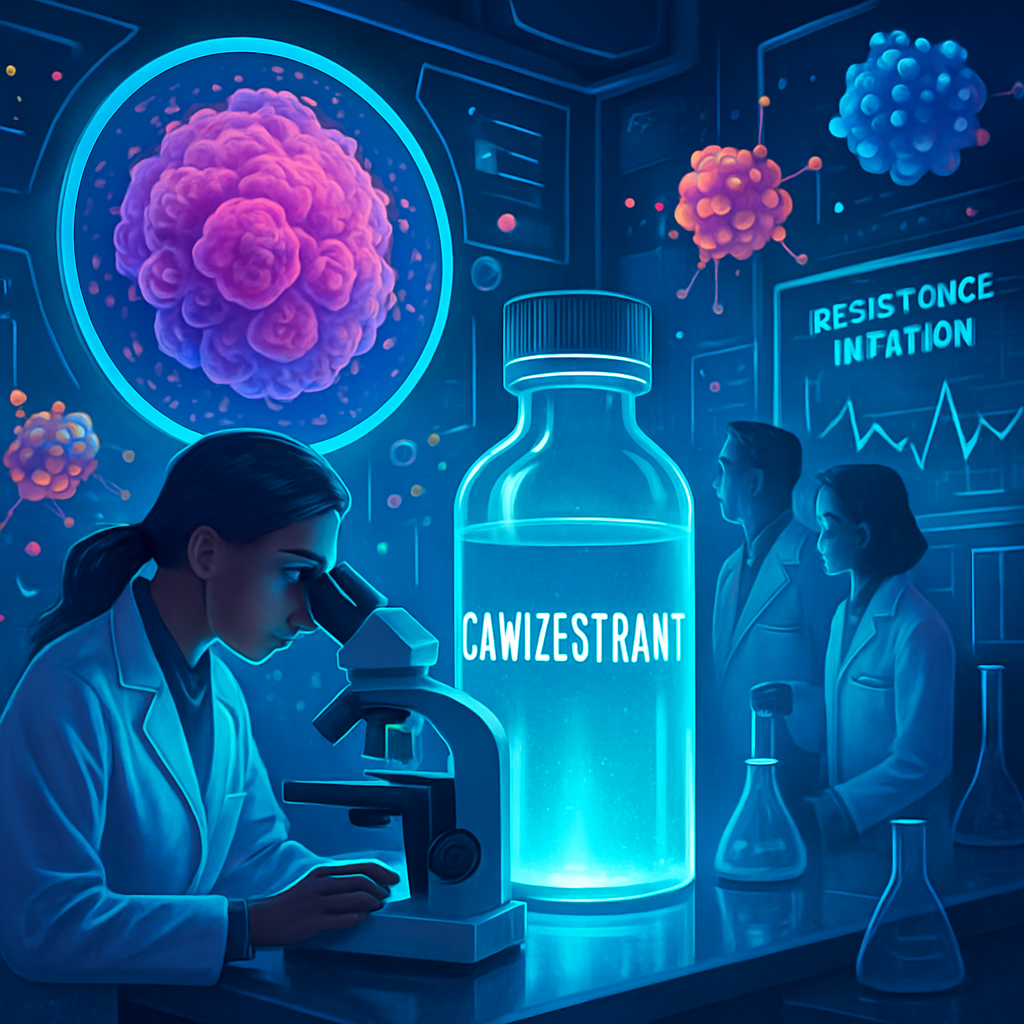
The FDA on Friday granted accelerated approvalopens in a new tab or window to camizestrant (Etcamah) for treating hormone receptor-positive/HER2-negative breast cancer at the first sign of ESR1 resistance mutations during first-line treatment.
Camizestrant is an oral selective estrogen receptor degrader (SERD) with an indication that stipulates use in combination with a CDK4/6 inhibitor when these mutations have been detected during combination treatment with an aromatase inhibitor (AI) and CDK4/6 inhibitor.
It marks the first approval in cancer where treatment is switched not because of radiographic progression but because resistance mutations are detected by circulating tumor DNA (ctDNA) in the blood, a decision at odds with recommendationsopens in a new tab or window from the agency’s outside experts.
“Since it is not yet confirmed whether intervening at this point, rather than at the time of confirmed disease progression, translates into a clinically meaningful benefit, the FDA has required confirmatory studies to verify and describe clinical benefit,” the agency said.
Camizestrant’s approval was based on results from SERENA-6opens in a new tab or window. In the phase III trial of patients responding to an AI and a CDK4/6 inhibitor, dropping just the AI in favor of camizestrant when ESR1 mutations were detected on ctDNA significantly reduced the risk of disease progression or death by 56%.
“The combination provides an important new option for the one in three patients with this form of advanced breast cancer whose tumors develop ESR1 mutations before clinical or radiographic disease progression,” investigator Kevin Kalinsky, MD, of the Winship Cancer Institute of Emory University in Atlanta, said in a press releaseopens in a new tab or window from drugmaker AstraZeneca.
The “approval will enable clinicians to promptly intervene and change therapeutic strategy at an earlier opportunity ahead of disease progression, rather than waiting until the cancer becomes harder to treat, and patient outcomes and quality of life worsen,” added Kalinsky.
Median progression-free survival (PFS) in SERENA-6 improved from 9.2 months for those who remained on the AI to 16 months with the switch to the next-generation oral SERD (P<0.00001).
But despite that PFS improvement, most panelists at a meeting of the FDA’s Oncologic Drugs Advisory Committee in April said the trial did not clearly establish a clinically meaningful benefit for patients who switched therapy on the basis of the ESR1 mutation. Overall survival data at the time of analysis were immature.
Common adverse events (≥20%) with the camizestrant plus CDK4/6 inhibitor combination included visual disturbances, fatigue, and decreases in neutrophils, leukocytes, hemoglobin, lymphocytes, and platelets.
Prescribing informationopens in a new tab or window includes a boxed warning for the risk of arrhythmia due to QTc interval prolongation when used with QTc interval prolonging drugs, including the CDK4/6 inhibitor ribociclib (Kisqali), as well as warnings and precautions for bradycardia and embryo-fetal toxicity.
The FDA also approved the Guardant360 CDx assay as a companion diagnostic device to identify patients with ESR1 mutations eligible for camizestrant.
Fuente: https://www.medpagetoday.com/hematologyoncology/breastcancer/122920
Join the doctors who get the most relevant medical news, curated by specialty, every week — no spam, unsubscribe anytime.