
A previously healthy 52-year-old woman entered the emergency department with a 4-month history of headaches and visual hallucinations. For the past month, her speech was incoherent.
When she reached the hospital, the patient was awake and alert, but unable to follow simple commands. Her speech was fluent but nonsensical, with paraphasic errors and impaired naming and repetition, reported Rolter Lorenz Lee, MD, of the University of Santo Tomas Faculty of Medicine and Surgery, and Bonifacio Pedregosa II, MD, of the Jose R. Reyes Memorial Medical Center in Manila in the Philippines, in the New England Journal of Medicine.
Her head CT showed several hypodense lesions with internal hyperdensities scattered throughout her brain, Lee and Pedregosa wrote. Electroencephalography (EEG) revealed posterior temporal interictal epileptiform discharges from the left side. Cerebrospinal fluid tests were normal.
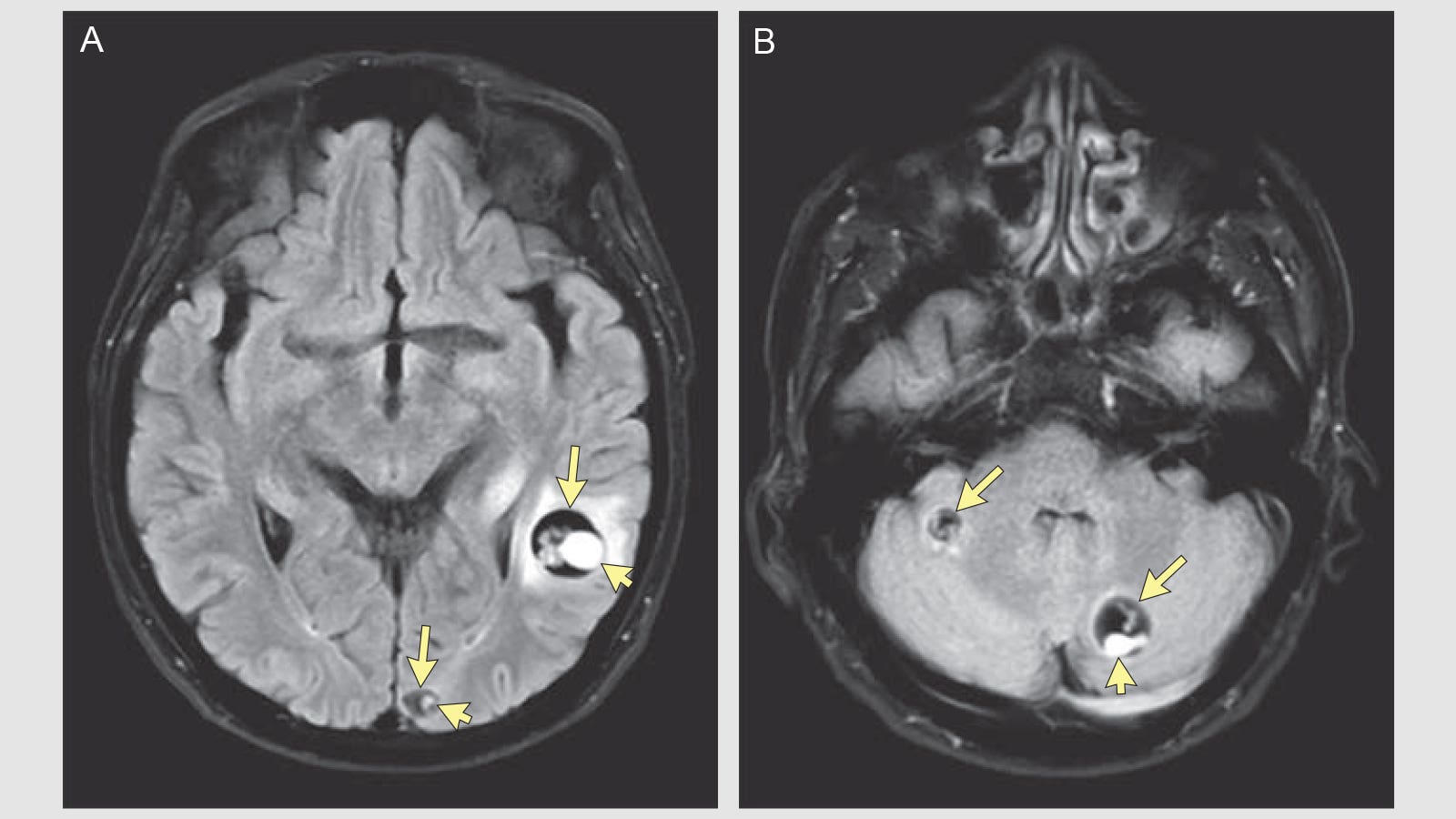
Her MRI scans showed cystic lesions in the temporal and occipital lobes on the left side, in the cerebellar hemispheres and frontal lobes bilaterally, and in the right parietal lobe. The cysts contained bright, off-center nodules representing the scolices (anterior end) of tapeworms.
Neurocysticercosis Diagnosis
What stood out most was the exceptionally clear demonstration of the classic ‘dot-in-hole’ sign, a pathognomonic imaging feature of neurocysticercosis that every clinician and radiologist should recognize, Pedregosa told MedPage Today.
Neurocysticercosis is a parasitic infection of the brain and spinal cord caused by larvae of the pork tapeworm Taenia solium. People get infected by swallowing tapeworm eggs, which can occur in contaminated food and water or can be picked up from contaminated surfaces. Poor hygiene and sanitary conditions will increase chances of infection, said Simon Groen, PhD, of the University of California Riverside, who wasn’t involved in the case report.
Infection Mechanism
Tapeworm larvae hatch from the eggs once these have arrived in the small intestine, Groen explained. The larvae may then enter the bloodstream and reach the brain. There, they can form cysts in which they shelter. These cysts press on the brain and release inflammation-inducing molecules. Depending on their number, sizes, and locations, they can cause symptoms including headaches, speech impairments, seizures, and difficulty with concentration, memory, or thinking.
The source of this patient’s infection could not be verified. An important aspect of the case, however, was its broad public health implication, Pedregosa said.
Public Health Implications
During the year preceding her illness, the patient’s home was destroyed by typhoons, and she had since been living in evacuation centers with poor sanitary conditions, he noted. The case underscores how displacement following natural disasters and inadequate sanitation in temporary settlements can increase the risk of neurocysticercosis.
While neurocysticercosis is more prevalent in other countries, it is a recognized public health challenge in the U.S. The CDC reports about 1,000 to 1,500 cases a year, but this is likely an undercount, Groen said. Estimates determined in the Nationwide Inpatient Sample pointed to approximately 2,300 hospitalizations per year in the period of 2003 to 2012.
Although case numbers have been trending downward since, more recent estimates from 2020 still point to a case number of around 1,500 hospitalizations annually, Groen said.
But these are just the cases that require hospitalization. Symptoms can sometimes be weak or overlap with those of other diseases, and infections are widely underrecognized, he said.
Cases are most frequently reported in New York, California, Texas, Oregon, and Illinois, according to the CDC.
Neurocysticercosis in Texas
Neurocysticercosis cases are not rare here in Texas, especially Houston, which is the most international city in the United States with large numbers of people from endemic areas of Africa, Asia, and Latin America, observed Peter Hotez, MD, PhD, dean of Baylor College of Medicine’s National School of Tropical Medicine in Houston.
There’s no question there is a lot of imported neurocysticercosis here in Texas, where it is a significant cause of seizure disorder, Hotez told MedPage Today. The unknown piece is how much of this is due to actual transmission in Texas.
Treatment and Follow-Up
The patient in the Philippines was diagnosed with parenchymal neurocysticercosis, Lee and Pedregosa reported. She was treated with the anti-parasite drugs praziquantel and albendazole and adjunctive glucocorticoids, and received levetiracetam for suspected seizures.
At 1-month follow-up, her symptoms had abated. MRIs showed smaller cysts without scolices. What was not expected was the patient’s excellent clinical and radiologic response, despite presenting with aphasia and multiple parenchymal lesions, Pedregosa said. This underscores the importance of early recognition and timely treatment of neurocysticercosis.
Disclaimer
The information provided in this content is for educational purposes only and should not be considered as medical advice. Always consult with a qualified healthcare provider for diagnosis and treatment options.
Fuente: https://www.medpagetoday.com/casestudies/neurology/122359
Join the doctors who get the most relevant medical news, curated by specialty, every week — no spam, unsubscribe anytime.